


A true tactical lighting system relies on the Two-Light Rule: a dedicated weapon-mounted light for target engagement and positive identification (PID), and a dedicated handheld light for navigation, search, and administrative tasks.
You cannot use one for the other. Scanning a room with a weapon light violates muzzle discipline; shooting with a handheld light sacrifices grip and recoil control. The Brinyte XP22 MK3 is your rifle core; the Brinyte PT16A is your handheld core.
✔ Home defenders building a reliable low-light setup
✔ Tactical shooters wanting to understand beam physics
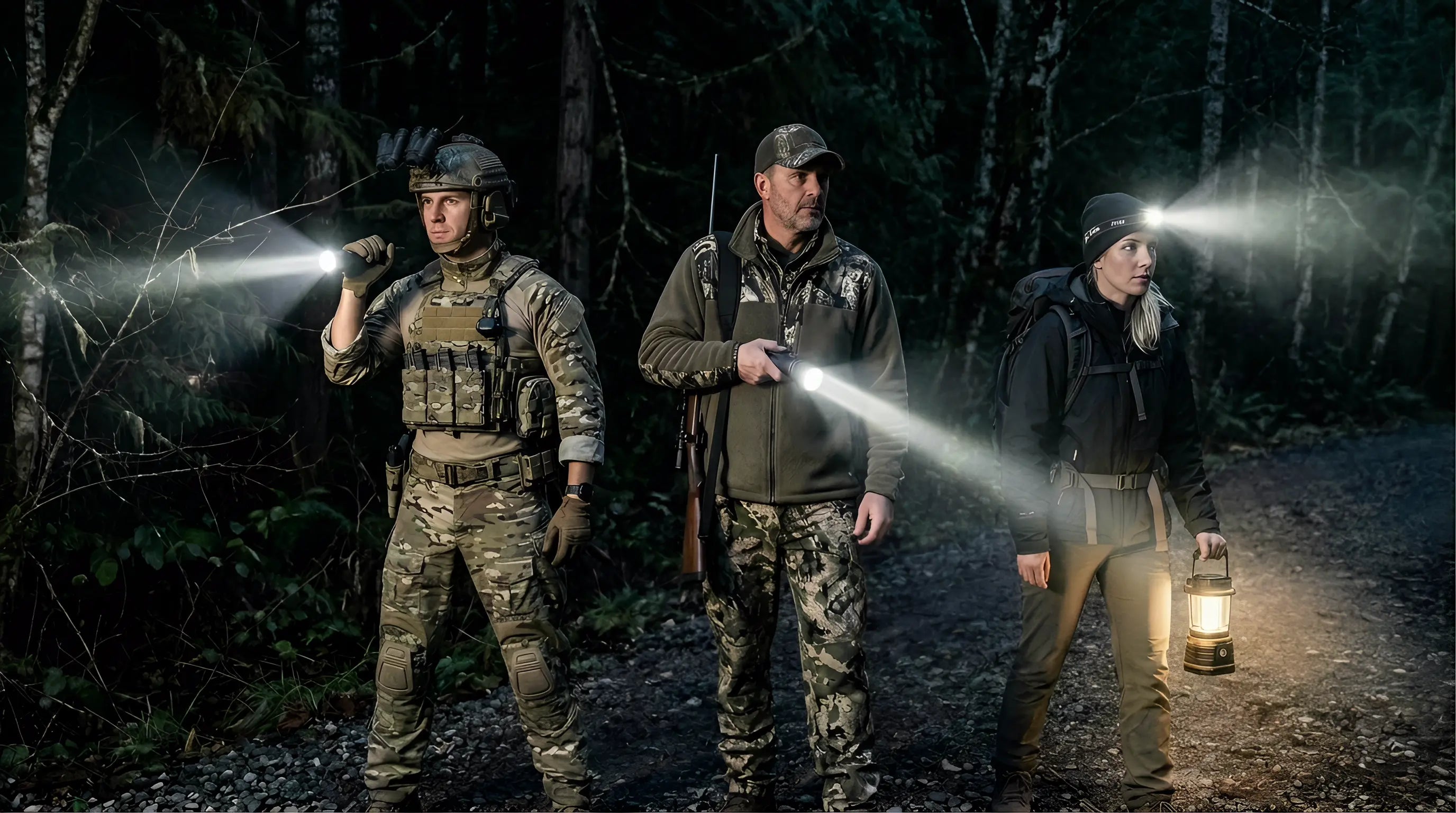
A tactical lighting system is not a single "do-it-all" flashlight. It is a coordinated setup where a weapon-mounted light handles threat identification and engagement, while a handheld light handles safe navigation and search. This separation prevents accidental muzzle pointing at non-threats and ensures optimal grip during firing.
1. The "Two-Light Rule" in Low-Light Tactics
Walk into any gear forum and you'll see the same argument: "Which light is the best?" The real question is: Best for what mission?
In low-light tactical environments, relying on a single light is a liability. The Two-Light Rule is the foundation of professional low-light tactics:
- The Weapon Light (Primary): Mounted directly to your rifle or carbine. Its sole purpose is illuminating targets aligned with your muzzle for positive identification (PID) and engagement. It must feature a momentary-on pressure pad or switch to prevent accidental give-away.
- The Handheld Light (Secondary): Held in your support hand. Used for navigating dark spaces, searching for switches, checking IDs, or administrative tasks. It ensures you do not violate safety rules by pointing your firearm at things you do not intend to shoot.
When your weapon light and handheld light share the same battery logic and switch ergonomics, your cognitive load under stress drops significantly.
2. Weapon Light vs Handheld — Core Differences
These two tools are engineered for fundamentally different physical interactions. Understanding these differences prevents buying the wrong tool for the job.
| Feature | Weapon Light (e.g., XP22 MK3) | Handheld Light (e.g., PT16A) |
|---|---|---|
| Primary Role | Target PID, aligned with muzzle | Navigation, search, backup |
| Switch Logic | Momentary-on (pressure pad or paddle) | Constant-on / Momentary Turbo / Strobe |
| Beam Profile | High candela (tight hotspot for distance) | High lumens (wider flood for situational awareness) |
| Mounting | Picatinny / M-LOK rail mount | Pocket clip / Ring grip |
| Activation | Activated via support hand thumb or pressure pad | Activated via tail cap switch |
A weapon light must activate instantly and turn off instantly the moment you release pressure. A handheld light must offer multiple modes (high/low/strobe) to adapt to changing administrative environments. Never use a handheld light as a primary weapon light unless absolutely forced to—it degrades your weapon retention and recoil management.
3. The Rifle Core — Brinyte XP22 MK3

For an AR-15 platform, the weapon light must clear your optic's sight picture without forcing you to buy an expensive riser. The Brinyte XP22 MK3 was engineered specifically to solve the modern LPVO obstruction problem.
Brinyte XP22 MK3 — 1,600 Lumens / 35,000 cd / $119.95
At 14.55mm above the rail, it sits completely below the sightline of any LPVO, red dot, or magnifier at 12 o'clock. It features independent switches—left for light, right for laser—meaning you never have to cycle through modes under stress. With 35,000 candela, it delivers 3x the beam intensity of a standard SureFire X300U, ensuring positive threat identification at extended distances.
Note: The XP22 MK3 is optimized for rifle rails. It is not designed for compact concealed carry pistols.
Shop XP22 MK3 →4. The Handheld Core — Brinyte PT16A

When moving through a structure or managing an administrative task, you need a light that offers raw output and flexible controls without touching your rifle. The Brinyte PT16A is built for this exact role.
Brinyte PT16A — 3,000 Lumens / 52,500 cd / $99.95
The PT16A features a dual tail switch layout—the primary switch handles momentary/constant turbo, while the secondary switch provides instant strobe activation. No mode cycling. No ambiguity. Powered by a USB-C rechargeable 21700/18650 battery, it also accepts CR123A backups via its dual-fuel architecture, ensuring you never run out of power in the field.
Shop PT16A →5. Lumens vs. Candela (The Reality Check)
The biggest mistake new buyers make is chasing high lumen counts. Lumens measure total light output; Candela measures peak beam intensity (throw).
Consider the Brinyte system:
- XP22 MK3 (Rifle): 1,600 lumens / 35,000 cd. It has lower total lumens than the PT16A, but a highly focused beam. This tight hotspot is critical for a rifle, allowing you to identify threats at 100+ meters without a wide flood blinding you with backscatter.
- PT16A (Handheld): 3,000 lumens / 52,500 cd. It delivers massive total output to flood a room with light for situational awareness, while still retaining enough candela to reach out to 458 meters if needed.
For rifle-mounted lights, prioritize candela (≥30,000 cd) to ensure positive identification at distance. For handheld admin/backup lights, prioritize a balance of high lumens (for wide flood) and sufficient candela (for reach). Never judge a tactical flashlight by lumens alone.
6. Frequently Asked Questions
Can I use a handheld light as a weapon light?
Not recommended. Handhelds lack proper momentary pressure switches, weapon-rated recoil isolation, and secure rail mounting. Using a handheld light alongside your firearm (like the Harries or FBI technique) is a valid backup skill, but a dedicated weapon light like the XP22 MK3 is vastly superior for primary engagement.
How many lumens for home defense?
For indoor use, 500–1,500 lumens is ideal. Too many lumens in a confined space will cause blinding backscatter from walls. The XP22 MK3 at 1,600 lumens is perfectly balanced for indoor clearing, while the PT16A at 3,000 lumens should be used in its lower modes for close-up navigation.
Are CR123A or 18650 batteries better for tactical lights?
18650 rechargeable batteries offer higher capacity and lower long-term costs, ideal for frequent training. CR123A lithium primaries offer longer shelf life and perform better in extreme cold, making them perfect for duty or backup. The PT16A supports dual-fuel, accepting both for maximum flexibility.
Build Your Two-Light System Today
Stop compromising your low-light setup. Equip your rifle with the XP22 MK3 and your support hand with the PT16A.
Shop Tactical Lights →About Brinyte
Founded in 2009, Brinyte specializes in tactical and hunting lighting engineered for real-world reliability. 50+ patents. ISO9001 certified. All tactical lights are ANSI FL1 tested.
👉 About Brinyte | Tactical Flashlights Collection | About the Author
"Professional tools for responsible operators — Brinyte."
Founded 2009 · 50+ Patents · ISO9001


